Showing posts with label Jewelry Buying Tips. Show all posts

01 October 2013

October's Opal Birthstone!

Shalom!

I hope everyone is doing well.  It has been crazy busy where I live.  However, I have been working hard on keeping you all informed on various things.  So, it is October.  This month is full of various holidays!  We have: All Hallows Eve, Samhain, Winter Nights, Thanksgiving (for Canada), Columbus Day, Nanomonestose, and a whole bunch of made up holidays like Mole Day and Sweetest Day.  For me, I have family with birthdays this month.  What is the birthstone of October?  The Opal is the traditional birthstone of October.  However, with Opal being a fragile stone, the alternative is Tourmaline.  Today I will be talking about the Opal, since it is the traditional stone.  So, on with the post!
Opal is a type of silica that contains about 6% to 21% water.  It is commonly found with sandstone, basalt, and rhyolite stones in Australia.  In fact, 97% of Opals in the world come from Australia where it is considered the national gemstone!  Some Opals come from Mexico or Oregon.  Fun fact, Opal is the only stone that can throw off every colour with minimal cuts to it. 
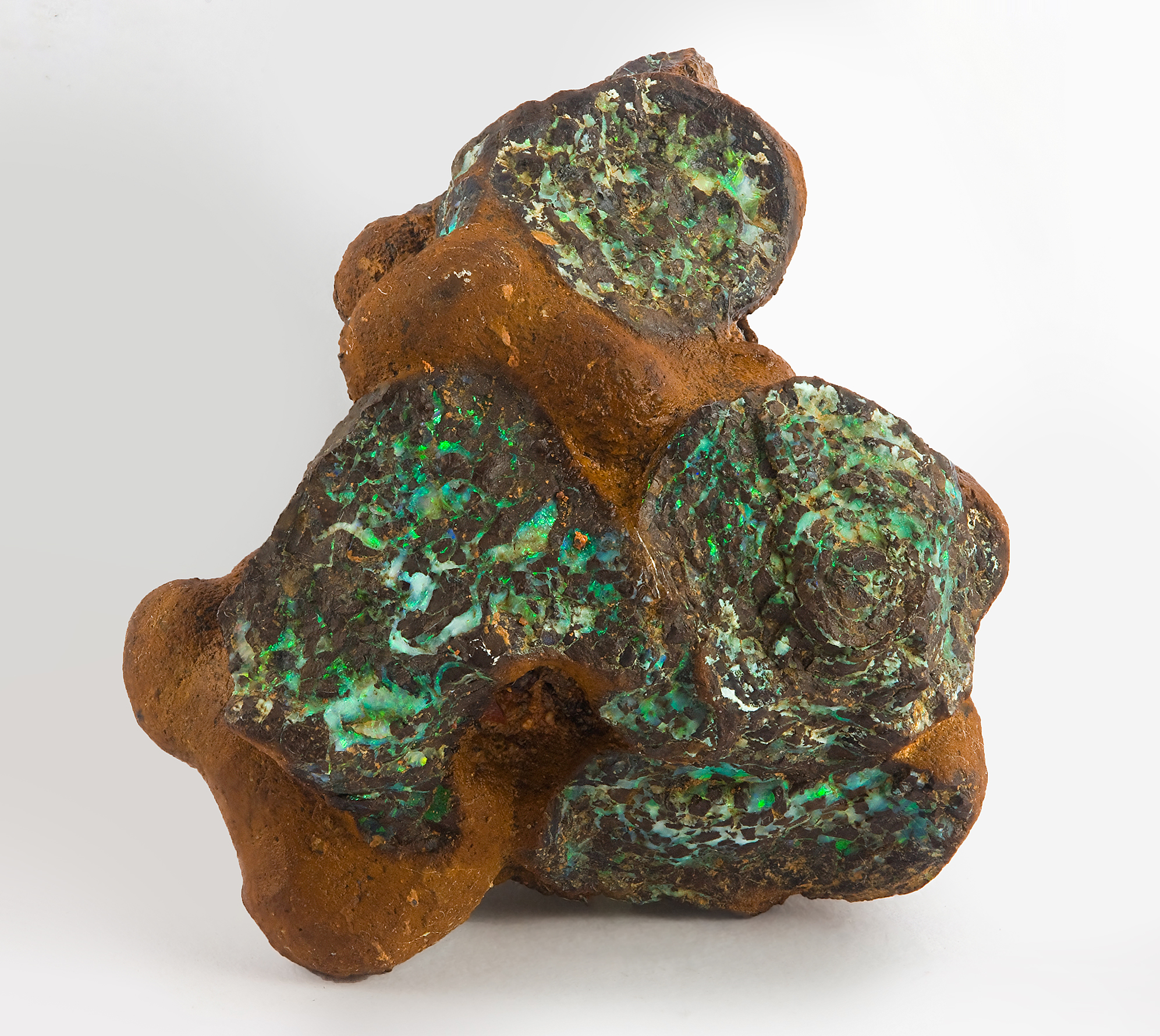
Speaking of Opal colours, it comes in many different colours.  The most desirable Opals are the ones that throw off the beautiful plays of colour.  Sometimes if the stone is clear and has a great amount of colour play it is called a Jelly Opal.  However, you can also find more that are a milky white, bluish green, yellow, brown, and colourless.  Many of these opals are not very desirable.  However, there are the beautiful Mexican Fire Opals and the Mexican Water Opals.  While they do not give off a great amount of colour play, they do throw off green flashes.  Fire Opals are a red to a yellow colour while Water Opals are clear with a blue green colour inside.  Black Opals are extremely hard to find and are considered to be some of the rarest Opal one can find.  However, Boulder Opal is even more rare and is very beautiful as well.  Boulder Opal is Opal that is found in small streaks within other the surrounding stones.  People will often polish the whole stone into a cabochon and make it into jewellery.
Opal
Boulder Opal
Fire Opal
 
Opal is almost always polished into a cabochon.  Because of the nature of the stone it makes it near to impossible to cut the stone.   The nature of the stone also makes it incredibly fragile!  You would not believe how many people come in to the jewellery store with broken Opals.  We have even gone to put a new Opal into a ring with an already broken stone and broke the stone we had to put in there.  It can be quite frustrating.  This is the reason why most jewellers will dread selling or even seeing Opal rings or bracelets.  If you are going to buy an Opal your best luck is going to be buying pendants and earrings.  Because of their fragility, imitation Opals are very common.  Thankfully, they are also incredibly easy to identify if you know what you are looking for.  Chances are, if it looks like thin little triangles or squares put together and sealed under something, chances are, they are imitation.  Very rarely are they real and a jeweller will let you know if what you are looking at is imitation.  If you come across a piece when you are out and about and you are not sure if it is genuine, there is a simple test that you can do at home!  If you hold the Opal in question under a UV light and it fluoresces then it is genuine.  If the Opal does not fluoresce under the UV light it is NOT genuine!  However, if in doubt just take it to your jeweller and they will be able to tell you if it is genuine or not.
Before I close, there is a common superstition that if you wear an Opal and it is not your birthstone it will break or you will lose it.  This is not true at all.  I have a PANDORA Pink Opal ring that I wear all the time at work and it has never cracked, never been lost, and I have never had any problems with it.  It is just a fragile gem and you have just as much chance of cracking it as someone born in the middle of October.
So, I hope you learned something new today about this beautiful stone.  If you have any questions feel free to ask! 

Until next time!  Stay beautiful and lovely everyone!

02 September 2013

September's Beautiful Blue Birthstone! Sapphires!

Greetings everyone!

Today I will be talking about September’s birthstone: Sapphire.  Sapphire is one of the four precious gems with the others being Diamond, Ruby, and Emerald.  Like the Ruby it is a form of corundum.  As such, if it feels like you have heard some of this before from a previous post you might have.  Anyways, on with the post!
The actual word Sapphire comes from the Greek word sappheiros.  Sappheiros means blue stone.  That is not to say that all Sapphires are blue.  On the contrary.  Sapphires come in a variety of colours some of which are: yellow, purple, orange, greenish blue, white, black, pink, and varying shades of blue.  Corundum can also come in a variety of red shades.  However, if it is red it is usually classified as a Ruby.  At times Pink Sapphires are called Pink Rubies.  Just know that they are the same thing just a different name.   The colour of the stone depends on what elements are found within the crystal structure as it is forming.  For example, Pink Sapphires and Rubies are corundum that contain chromium.  Vandadium causes the stone to be purple.  White Sapphires contain titanium.  Yellow and Green Sapphires have Iron insides of them.  The Blue Sapphires are created when both Iron and Titanium are present in the crystal as it is forming. 

So, where do Sapphires come from?  Many of the same places that Rubies do!  However, the most famous Sapphire mines in the world are in Kashmir, India.  India has many of the Sapphire and Ruby mines, but they are also found elsewhere.  These include various places in the Indo-China region,  Malawi, Nigeria, Australia, and the United States.  Montana has most of the United States’ Sapphire mines.
Well, now that you know about the colour of Sapphires and where they come from it is time to move on to some more important things.  Like all gems Sapphires have inclusions.  If they do not have these you may be looking at a synthetic Sapphire. Unlike Rubies though, most Sapphires do not have lead glass filling, fracture filling, or any other form of inclusion filling treatment.  Why is this?  Because by heating the Sapphire not only does it increase the blue colour of the stone, it also loses what jewellers call the silk of the stone.  What is the silk?  The silk is what is causes the inclusions to be visible.  When heated it vanishes and the stone becomes clear.  The practice of heating Sapphires is so common that if it is NOT heat treated it will sometimes come with a certificate saying that it was not heat treated rather than the other way around.  Sapphires have been heat treated has been going on since the time of the Roman Empire.  As such, it does not reduce the price of the stone.  If any treatment that the Sapphire receives has an effect on the stone, be it a negative or a positive, it must be disclosed in accordance to the USFTC.

Well, that is all for now.  I hope you all enjoyed this and found it interesting!  Until next time!
Love you all!

21 August 2013

Peridot: August Pretty Olive Green Birthstone

Hello everyone!

I have exciting news.  In addition to having my book published, I might be moving to London!  I have been super busy trying to get everything all situated.  I have been applying to jobs over there in management positions, some of them I was asked to apply for.  For those of you who do not know, some of my cousins live in England and some of my ancestors are from that area.  I would dearly love to be able to go visit family and see the places were my family once lived.  My family is a close knit family even though we live pretty much all over the globe.  I just got a package from my cousins in Canada the other day.  Where I live we cannot get the commemorative Royal Baby Carriage PANDORA charm.  My super amazing cousins were able to snag me one and shipped it to me.  I also went to visit my aunt last weekend and got my Miss Hedgehog charm.  This is another reason for my posts being delayed.  My aunt has not been in good health recently and we’ve been worried about her.  Also, I have had some dental work done and that has been a not so welcome treat.  I hope to be getting back on my posting schedule though.  Fingers crossed.
Anyways, today I will be talking about August’s birthstone: Peridot.  This word is mispronounced nine times out of the ten.  The “t” on the end is silent.  DON’T PRONOUNCE THE “T” AT THE END!!!  This is just one of those things that annoys the ever living daylights out of me and every jeweller that I have met.  It is pronounced like this: Pear-eh-doe.  See, it is really easy to say it correctly.  Please do so.  On with the post.
Peridot is a light green olivine mineral.  While most of the time it is a yellow-green or lime green in colour it can also be found in greenish brown and dark olive green.  However, to be a Peridot it must be an olive green.  The green colour is caused by iron in the crystal as it forms.  How much iron is in the crystal determines the colour of the stone.  The darker the olive green, the more expensive it will be since finding dark olive green Peridot is difficult.  The lighter shades of Peridot are fairly easy to find in terms of gemstones and as such it is deemed a semi-precious gem.
So, where dose Peridot come from?  Olivine stones are very abundant and can be found from the Earth all the way to far off asteroids.  Apollo 15 even brought back an Olivine stone from the moon!  On Earth though, it is fairly common and is usually found in Mafic and Igneous rocks.  This basically means that Olivine is found in volcanic areas.  In fact, Papakolea Beach in Hawai’i, Talofofo Beach in Guam, Punta Cormorant Beach in the Galapagos Islands, and Hornindalsvatnet in Norway are all green sand beaches.  The green sand is actually small olivine stones that have been eroded from nearby lava flows or Mafic rocks.

For some strange reason, many people do not find the colour of Peridot appealing.  This has always confused me as there are so many different shades of olive green it can come in.  Even though the dark green Peridot is the most desired, I find that the light almost lime green shade is very pretty.  Dark stones, if you are willing to pay for them, are sometimes mistaken for the more expensive Emerald.  As with the Emerald, it may be that many people prefer a white metal jewelry which does not suit the colour of the stone well.  Green gems look better in a yellow gold mounting as the yellow can enhance the colour.  Here is a picture of several different cuts and shades of Peridot for comparison.
 
So, now that you know about the Peridot what about buying them?  Since Peridot is not a horribly rare stone, it is not the most expensive of gems.  In fact, buying a Peridot ring in 14K gold can cost you as little as $100!  Most of that price is in the mounting itself and not the stone.  As such, the chances of getting a fake Peridot are not that high.  You can go to your local jeweller and buy loose Peridot stones starting at $6 for a small one.  If you have any questions a quick trip to your local jeweller will let you know.  However, I will tell you this much, if you are paying over $2,000 for a Peridot ring you might want to ask why.  If it has diamonds in it, that might bump the price up.  If it is in 18K gold, that can also bump the price up.  However, you can find Peridot rings with about a quarter of a carat of diamonds set in 14K gold for about $1,500 plus taxes.  So, if in doubt always ask.  You do not want to end up over paying for Peridot! 

I hope that this has been helpful to you all and that you learned something!  For those of you who would like to see it, below is a picture of the Royal Baby Carriage charm as well as the Miss Hedgehog charm!  Also is a link to my book if you all would like to purchase it.  For some reason when the book was formatted it caused some strange errors that were not there in the finished manuscript.  I apologize for that.  Hopefully when the second book in the series comes out and the new edition of this first one is released it will resolve itself.  You can also go purchase it at your local bookstore.  Anyways, enjoy!
 
Stay lovely everyone!

Fractured Bottles
Fractured Bottles for Kindle

03 July 2013

Rubies! July's Beautiful Red Birthstone!

Hello everyone!

So, it’s July. Lots of things happen in July so I am making my post as early as I can. The 4th of July is tomorrow, my tribe has our encampment later this month, I have lots of family members with birthdays this month, and for those of you who do not know, my birthday is in July. That means that my birthstone is the Ruby. Today I will be talking about Rubies. So, since I have a lot of stuff to get done in a short amount of time, let’s get this going!

The Ruby is a red stone and is one of four precious gems that are considered birthstones. The other’s being Diamond, Sapphire, and Emerald. The name for this stone comes from the Latin term ruber which means red. It, like Sapphire, is a form of corundum.  The red colour that it has come from the chromium being found in the stone when it is forming. Rubies are usually mined in Asia and the finest rubies have historically been found in Burma, or Myanmar as it is known now.  So, if you have heard of Burmese Rubies, that is where they come from.

So, why are pink forms of corundum called Pink Sapphires and not Pink Rubies? I have often wondered this myself. The truth is, in the a lot of other countries throughout the world pink corundum is classified as a Ruby and not a Sapphire. In the United States corundum must be a certain shade of red before it can be called a Ruby. All other are considered Sapphires. Speaking of colours in Rubies, the most desirable colour of this stone is called a pigeon’s blood ruby. They are very expensive and usually only can be found in the area around Burma. Most Rubies will have what is called a secondary hue. This means that some Rubies will have a slight purpleish shade to them or an orange shade to them. Most of the time it is not notice able, but it can have an effect on the price of a stone. An interesting thing to note is that Rubies look better when set in yellow gold. The reason for this is that the yellow of the gold will neutralize the blue tones in the stone and make the Ruby look more red than it would if you were to set it in another colour of gold.

Now we come to the part that is important to know. Why is it that some people when they go to the Middle East can buy Rubies really cheap and then come home to find out they are worth next to nothing? The answer is simple. A great number of these Rubies are called Glass Filled Rubies or Lead Filled Rubies. Whichever term is used it means the same thing. What happens is that when a Ruby comes out of the ground it will, like all gemstones, have inclusions and these inclusions are filled. The substance to fill these inclusions and make them look more transparent and desirable is Lead Glass. Many times people will not know that there is Lead Glass in the stone. Many times the only way to tell if the Ruby has been filled is to take it to a jeweller who will run a test on it. While they may look pretty, when it comes to setting filled stones is that many times they will crack when they are being set because if any heat is applied to the piece the Lead Glass will react to the heat and cause the stone to break. Sad, but true. Most people do not know that what they are getting is not so great stone. However, if you buy your stones at your local jeweler they will be able to tell you if the Ruby you are buying from them is filled or not. Most jewellers will NOT sell Lead Glass or treated Rubies. They are not valuable and if they break it falls back to the jeweller and they should pay to replace the stone.

If you come across a Ruby that you have your doubts about, ask the person that you are buying it from if they are willing to have a jeweller take a look at it before you purchase it. If they say they do not want a jeweller to examine it, I would not purchase it. The reason being is that if they know their stones are genuine and not Lead Glass filled they will have no reason to be offended if you are simply wanting to double check. If they know their stones are NOT genuine they will usually act defensive about it and will not even want to do business with you. People that are proud of their products will want you to be as happy with the product as they are and will do whatever it takes to make you happy. So, if in doubt ask. It is always better to be safe than sorry. Especially when it comes to expensive gemstones.

Well, I hope that you all found this informative and interesting! If you have any questions for me about Rubies feel free to ask! Also, if you are wondering what the alternate genuine birthstone is for July it is the Carnelian stone. It comes in colours ranging from orange to dark reddish-brown. It may also be called Sard, or Red Onyx.

Have a wonderful and safe Independence Day to all of my American readers and a big Thank You to all of our troops that are stationed around the world! My father was in the military, as well as numerous cousins and other relations of mine, and I know how hard you all work to keep us back here at home safe. We appreciate all that you have done and continue to do for us!

18 May 2013

Emeralds! May's Birthstone

Hello everyone!

I have been getting ready to go on vacation in a couple of weeks, so please bear with me. I am slightly frazzled at the moment. That being said, I have a new, and hopefully informative post for you all. I will be posting these, theoretically, at the first of each month since they are going to be about birthstones. I will possibly continue the posts afterwards with information about other gemstones, but for now, just gemstones. That way you will all get at least one post a month. Hope you all enjoy them! It gives me a way to use the stuff that I have learned in my classes and at work.

So, this year’s big colour is emerald green. Well, the emerald is May’s birthstone. Emeralds are a type of beryl which puts them in the same mineral class as March’s birthstone, Aquamarine, and the beautiful pale pink Morganite stone. It is very pretty and can be found in numerous jewelry settings. You can get find them set in all colours of gold. However, most jewellers will tell you that the most common and beautiful setting for an emerald is in yellow gold. In terms of the cut, most emeralds are cut in what is called and emerald cut. They are available in other cuts, but the emerald cut brings out the beauty of the emerald and is a good stable cut for the stone.

A question that I get asked a lot is where do emeralds come from? Well, that depends on what time period you are living in. If you were to live in ancient times you would most likely get your emeralds from places like Austria, Egypt, and India. However, in today’s world you can find emeralds just about anywhere if you know where and how to look for them. Most emeralds come from Colombia and Zambia though. Colombia has the most emeralds, however those that are mined are softer than those mined in Zambia.

Speaking of emerald softness, all emeralds have inclusions in them. When buying emeralds be wary of buying one that has none. Chances are, if it has no inclusions it is either a synthetic emerald or an emerald green cubic zirconia. A synthetic emerald is grown in a lab. Really, there is nothing wrong with lab grown emeralds apart from they are not brought out of a lab. That being said. If a jeweller tells you that the emerald has no inclusions always ask! I cannot stress this enough. The store that I work for has both kinds and all of us know which is which. If in doubt of it, ask. Most jewellers will have no qualms about telling you anything and everything you want to know about the stone you are interested in. If they do not want to tell you, you may be better off buying somewhere else. Also, do emeralds are one of the stones that you do not want to buy online. Not only do you run the chance of not getting a real emerald, but the shipping may damage the already fragile stone. You have no idea how many people we get coming into the store asking us to replace cracked emeralds.

What colours do emeralds come in exactly? While most emeralds are a beautiful medium green, it is not uncommon to find some that are little more blue or a little more yellow. They are still emerald, but it is the medium green that people want. If you get too blue you end up with different species of beryl such as aquamarine and maxie. If you go to yellow you end up with Golden beryl and heliodor. So, what makes an emerald green as opposed to another colour of beryl? Emeralds contain small amounts of vanadium or chromium. Chromium being the most common. Yes, chromium is the chemical that was causing all those problems if you have seen the film “Erin Brockovich” or know anything about the case that Erin Brockovich worked on in real life. That being said, the type of chromium in that case was hexavalent chromium and that is NOT found in emeralds. Hexavalent chromium is chromium in the sixth state of oxidization. Unless you are going to be ingesting large amounts of emeralds you will be fine wearing it. It will not harm you to wear an emerald.

Emeralds, as mentioned above, have inclusions in them. Most emeralds have a lot of inclusions in them. As such, most emeralds look more opaque than clear. However, you can buy very clear emeralds if you want to dish out that kind of money. The clearer the emerald, the more money it is. The good news is that most lapidarists will oil the emeralds to give it a more clear look to it. The most common type of oil used is cedar oil. You can ask your local jeweller about the oiling of emeralds if you so wish. Most jewellers will be able to tell you if the emerald you are wanting to purchase has been oiled or not. However, not all emeralds are oiled. Some may be treated with synthetic oils. In the US the FTC requires that when an emerald is sold the person buying it must know about it. There is a downside to this though. A company may buy and emerald to set in a piece of jewellery and know that the emerald has been oiled. When that company goes to sell to your local jeweller the salesperson may not  know if that emerald has been oiled when they are selling to your local jeweller. So, if you jeweller tells you that they are not sure if the emerald was oiled during its time at the lapidary they very well may be telling the truth. Nonetheless, most emeralds are in fact oiled and as a good rule of thumb it is safe to assume that the emerald you are interest in and all other emeralds in your local jewellery store are in fact oiled.

Another question that I get asked frequently is how does one take care of an emerald. Since emeralds are so fragile with all of their inclusion it is better to have your emerald set in a piece of jewellery that does not get banged around. Pendants, brooches, earrings, and hair pins are all good choices. Rings and bracelets tend to take more abuse since people use their hands for various things throughout the day. So, if you want a ring or bracelet you may consider purchasing a lab created emerald instead as they hold up better since they do not have very many, if any inclusions and are harder than mined emeralds. Do not put them in harsh chemicals. Always take them off before working with chemicals of any kind just to be on the safe side. If you wish to clean them, use water to gently rinse them off and then dry them with a soft cloth. It is better to take your emeralds to the jeweller to have them cleaned professionally. Most jewellers do not charge for cleaning. If they do it is usually not that much. Also, just because your emerald has been oiled at the lapidary does not mean that it needs to be oiled again. If your jeweller thinks it needs it they will tell you. In which case, if your jeweller is a trained lapidarist they will do it themselves, or they will have a lapidarists come in to do it. On occasion, they will either take it to the lapidarist or send it to them. As with most jewellery care, if in doubt ask your local jeweller.

I hope this has helped you and that you have found it interesting! Until next time!

25 March 2013

Gold Jewelry and How to Identify it

Hallo Welt!

A bunch of things have come up and I have not been able to get around to posting as much. I am sorry! I hope you all found my last post about pearls and how to buy them helpful! Working in the jewelry business, I get a lot of people that do not know exactly they are looking for when it comes to pearls or what they should look for. Today I will be talking about gold and what those stamps on the inside of your jewelry mean. I hope you find it informative and helpful!
When people think of jewelry the first thing that usually pops into one’s head is gold and diamonds and that it is really expensive to get those. This is not necessarily true. When it comes to gold jewelry there are some things to know.
First is that gold jewelry is not made of 24 karat gold. 24 karat is too soft and will fall apart. If a jeweler tells you that it is you are probably getting 24 karat gold plating over a base metal or silver. While it looks pretty, it isn’t very practical for everyday wear as it will wear off. The highest karat of gold most jewelers will carry is 18 karat gold. 18 karat is usually found in countries like India and China. In terms of karat gold the lowest that a jeweler will usually have is 10 karat. 10 karat isn’t horribly expensive, but it is brittle. Getting it in contact with chorine from swimming pools or bleach can destroy it. Sometimes you will find 12 karat gold. However, the only place I have seen that is in Turkish jewelry. The most desirable of karat gold for jewelry is 14 karat. It is not brittle like 10 karat and it is not too soft like 18 karat.
Another thing to take into consideration is the colour of the gold. The most common colours are yellow, white, and rose. Gold comes out of the ground as yellow and as such is the most common of the colours. White gold is often mistaken as silver for someone who does not know much about precious metals. White gold is gold alloyed with one of two white metals such as nickel or platinum. If you are allergic to nickel sometimes it is best to stay away from white gold. Thankfully, if you want the white metal look most jewelers are able to accommodate you with a variety of other white jewelry metals. Rose gold is also called pink gold, Russian gold, and red gold. It is made by mixing copper with the gold to turn it into a red to pink and sometimes orange colour. Other colours of gold include green, grey, black, purple, and blue. Green golds are made with silver mixed in. These golds will have variety of different shades and often one cannot tell if it is green or yellow gold until the two are placed side by side. Grey gold is different from white gold in that it is darker. Grey gold usually contains silver, manganese, and copper. Black gold is made in several different ways, but usually will contain cobalt and chromium. However, one can just as easily get the same effect by using a black rhodium plating (I will explain what rhodium is in a later post). Purple gold is made with high gold-aluminum intermetallic aluminum. This metal is more precious as it is a minimum of 18 karat gold a good majority of the time. Blue gold contains indium as its alloy. However, it may be pretty, blue and purple gold contain non-noble metals and can discolour when exposed to sweat.
So, what do those symbols on the inside of your ring and on the closures of your necklaces mean? When it comes to karat gold it will be marked 10kt, 12kt, 14kt, or 18kt. If it is marked anything other than that it is probably not gold. However, some countries will stamp the piece differently. For example, my favorite piece of jewelry that I own is a rose gold Jerusalem cross that is marked Au750. That means that it is 18 karat gold. If in doubt go to your local jeweler! Chances are that they will not charge you to check. Platinum is usually marked with the word or Plat. and is pretty easy to identify. If a piece is stamped .925, 925/100, or STERLING then it is sterling silver. Identifying silver from countries other than the United States can be tricky. When it comes to silver mad in the United Kingdom and Ireland you have other marks to identify. Again, your local jeweler should be able to identify whether or not your piece is silver or not. However, here is what to look for when looking at UK or Irish silver. Because the British still use the silver standard for their currency you must look at a series of stamps when trying to figure out what it is. On the plus side, if your product is faulty you can trace it back directly to the person that made it most of the time. The first mark to look for is the assayer’s mark which will tell you the purity of the silver. This is shown by a lion passant or, in the case of an Irish made piece it will be a harped crowned. Next to look for is the date mark which will tell you what year the piece was made. The city mark will vary to show you which city it was made in. The final mark on a British piece to look for is the maker’s mark which is the hallmark used to show who made the piece. Irish made products will also have Hibernia stamped on it. Older marks not used today are the duty mark that showed how much tax was to be collected on the piece, in use from late 1784 to 1890, and the tally mark which was used by a journeyman apprentice so that they could be paid correctly. The French also use various silver marks that have the head of Minerva and will be 95% silver or higher unless a 2 is stamped next to Minerva’s head. If the French piece was made for export it will have the head of Mercury and a stamp to show the purity of the silver between 1 and 3, 1 having the highest and 3 having the lowest silver content. As with the British hallmarks, French hallmarks also have a maker stamp.
Something to keep in mind is that just because it is gold and has a clear stone in it does not mean that it has a diamond in it! Sometimes it is a semi mount that has a cubic zirconia placed there for show. It could also be white topaz, white sapphire, or any other white gemstones. Also, just because it is silver does not mean that those white stones are not diamonds. They very well may be diamonds. Just ask the jeweler at the store and they will be able to tell you.
Hope this helps you! I will be trying to keep this more up to date as best as my time allows.
Until next time!

03 December 2012

Fashion Trend! Coloured Pearls and How to Buy Pearls

Hallo everyone!

My apologies! I was not expecting to get so busy at the store! Wow! It’s been crazy; especially because of the Black Friday/ Precious Gift Limited Edition Charm for Pandora.  However, I am back and hopefully I will be able to update this and my recipe blog more often.  I got a fancy new smart phone and have set a weekly alarm to update on here once a week. Let’s see if that will kick my butt in gear.

Today I will be talking about a newish fashion trend.  Honestly, I wasn’t sure if this was going to catch on or not, but apparently it did.  I am pretty happy it too. Today I will be talking about coloured pearls! They are really pretty and a good spin on an old classic. Also, I will be giving you some important information on buying pearls! This will help you when you go into your local jewelry store to buy.

First things first, as a person in the jewelry business will give you some helpful tips on buying pearls. The first thing you need to know is that there are different types of pearls. The four major groups are: Freshwater, Saltwater, Cultured, and Faux.

·         Freshwater pearls are quite a bit cheaper, but are genuine pearls. They are made inside of freshwater dwelling mollusks usually found in lakes and rivers. River pearls, for example, are a type of freshwater pearl.

·         Saltwater pearls are quite a bit rarer and are fairly expensive if you are buying a good quality set. They are usually found by pearl divers in what are called “pearl oysters” Sometimes, if you are lucky, you might find a pearl inside of your oyster at a restaurant or in the cans of oysters at the store that was missed.

·         The last of the genuine pearls is what is called a cultured pearl. These are the most common type of pearl sold in the United States. They are inexpensive when it comes to real pearls and can be dyed numerous colours, that isn’t to say that other natural pearls cannot be coloured or cannot be naturally coloured. I will discuss coloured pearls here in a moment I promise!  Cultured pearls are created by putting a piece of what is called “donor oyster” inside of the mollusk to grow. They look like other pearls, but are not fake!

·         Faux pearls are the cheapest pearl that you can buy. They are not real pearls and can be made of numerous materials. The most common ones are made of glass or plastic with an opaque “pearl” coating. Some can look incredibly real. That is where people often get taken advantage of at non-jewelry stores. They look real and if you do not know what you are looking at you may end up paying genuine pearl price for plastic beads.

Next you need to know about pearl shapes. Their seven basic pearl shapes. These are Round, Oval, Circlé, Button, Baroque, Biwa, and Mabé.

·         Round pearls are just what it says they are. They are round and are the most desirable shape. They can be fairly rare. However, they are not as rare as an internally flawless and completely colourless diamond. Typically the only place to buy round pearls is at a jewelry store. These pearls come with knots between each pearl.

·         Oval pearls are more oval shape than round. Most non-jewelry stores sell these. You can find them at jewelry departments at retail stores. These pearls will come with knots between the pearls.

·         Circlé come in several shapes, but they all share a common feature. All Circlé pearls have rings on their surface.  They are fairly uncommon and usually used for pendants and earrings. Circlé pearls will be knotted between each one.

·         Button pearls are similar to a round pearl when viewed from the front and this is how they are set. When you look at them from the side they are more oval. You can buy these at retail stores where they are sold as “round” pearls. These are usually used in earrings or rings. If used as a bracelet or necklace they will be knotted.

·         Baroque and Biwa pearls can both be classified irregular pearls. No two of these pearls are shaped the same.  The difference between these two shapes is that Baroque pearls are usually larger than Biwa pearls. Also, Biwa pearls are named so because they come from Lake Biwa in Japan.  These pearls may or may not be knotted between each pearl.

·         Mabé pearls are formed on the inside of the shell rather than inside the oyster “meat”.  They are basically half rounds. When they are removed from the oyster shell they affix a mother of pearl backing on them. These are used in rings and earrings. They are not suitable for stringing. The only time you find them in a bracelet or necklace they will be set in a Mabé mounting.

There are numerous other things that will have an effect on the price of the pearl. However, those are mostly used for jewelers when they are pricing them. These include the Complexion, Size, and Luster of the pearl. If you are curious about them you can ask your local jeweler in relation to the pearls you are interested in.

Now we come to the fun part! Coloured pearls! Pearls come in all colours and not just white. I had a friend that when she got married she wanted orange pearls and had a hell of a time finding them. Thankfully, the store I work at was able to find just the shade of orange she was looking for. Currently my store has cranberry, brown, black, peacock, lavender, white, and cream pearls in stock. My personal favorite is the cranberry which is a pinkish red. The coloured pearls are graded differently than the white and cream pearls. They come in all sizes and shapes. 
This is a picture of "loose pearls". This means that they have not been strung into a proper necklace or put in a propper setting. This picture shows the orange pearls that I was talking about earlier. There are also strands of pale pink, white, and cream.

If you are looking for something that will match most everything you wear then white, cream, or black would be the way to go. However, if you are looking for a fun fashion statement to match your favorite dress then coloured pearls would be the way to go. Also, if you are looking for something to add a bit of colour to your LBD or LWD then coloured pearls are perfect for this!

Something to keep in mind with coloured pearls, and all coloured gems really, is that certain colours do not look good with certain skin tones. It is the same way with make-up. I do not look good wearing brown pearls for example. However, I do look okay with the cranberry pearls. It all depends on skin tone.

Coloured pearls are fun and are in fashion right now! As are coloured diamonds! Just go into your local jewelry store and check out the different colours of pearls they have. They may not have them in stock that day, but more often than not they have the ability to order them in for you in whatever length you need.

When it comes to length there are some things you should know. Rather than saying you want a 16 inch pearl strand, each of the standard lengths has a special name that it goes by. They are as follows.

·         10 inch to 13 inch necklaces are called a collar length. These are commonly made up of several strands rather than one strand. They also do not hang down at all.

·         14 inch to 16 inch necklaces are called pearl chokers. They hang right at the base of the neck.

·         17 inch to 19 inch necklaces are called a princess length necklace. These are the most popular strands. They are not too long and they are not too short.  Also, they go with pretty much anything from scoop neck dresses and blouses to plunge neck dresses and blouses.

·         20 inches to 24 inches are called matinee length strands. These look good with a lower cut dress or blouse.  

·         28 inches to 35 inches are referred to as opera length necklaces. These were traditionally the length that one would where when going to the opera when doing so was considered a special occasion.  However, today they are worn with a variety of dresses and blouses. These look particularly cute with turtle neck dresses because they stand out and add depth to your dress.

·         45 inches and longer are called a pearl rope. These typically do not have a clasp of any kind, but rather go over the head and longer strands may be wrapped around several times.

Hope this helps you when you go out to buy your pearls! Pearls are classic and no girl should go without at least one strand of pearls!

Stay lovely and happy!